
10.30 AM - 7.00 PM
Please call +65 8184 1686 for the showroom visit appointment.

The majority of DIY smart lighting projects in Singapore fail to deliver on their core promise, plagued by connectivity drops and non-compliance with critical safety standards. You've envisioned a home where lights respond to your voice and schedules adapt to your life, only to be met with flickering bulbs and unresponsive apps. It's a common frustration, rooted in the unique architectural and electrical challenges found in local HDBs and condominiums.
This 2026 guide moves beyond generic advice. We will equip you with the strategic knowledge to architect a professional-grade smart lighting installation Singapore residents can rely on, ensuring your system is not just intelligent, but impeccably stable and secure. We'll dissect everything from navigating legacy wiring without a neutral wire to selecting EMA-compliant hardware and designing a robust mesh network that conquers concrete walls, transforming your vision of seamless automation into a flawless reality.
True smart lighting transcends the simple act of swapping a bulb. It’s the architectural integration of a responsive electrical ecosystem into your home. While standalone smart bulbs offer a taste of automation, a professional smart lighting installation in Singapore engineers a cohesive infrastructure designed for reliability, safety, and strategic value. This approach moves beyond simple gadgets to deliver tangible benefits in energy optimization, wellness through circadian rhythm alignment, and a measurable appreciation in your property's market value.
In Singapore's high-density residential landscape, electrical safety isn't a luxury; it's a mandate. The Singapore Civil Defence Force (SCDF) consistently reports that a significant portion of residential fires, approximately 23.5% in 2022, originate from electrical faults. Many homeowners fall into the "JB Hardware Trap," importing non-certified smart switches and devices to save a few dollars. These unverified products often lack the engineering to handle Singapore's 230V/50Hz electrical standard safely, posing a direct fire risk. Every controlled electrical product sold locally must bear the Enterprise Singapore SAFETY Mark. This isn't a recommendation; it's a legal requirement that verifies the product has passed rigorous testing. In the event of a fire, insurance investigators will scrutinize the cause. If found to be an uncertified device, your fire insurance claim, potentially worth hundreds of thousands of dollars, can be legally invalidated.
Standalone smart bulbs often fail to deliver a seamless experience in Singaporean homes. The dense, steel-reinforced concrete walls common in HDB flats and condominiums severely attenuate Wi-Fi and Zigbee signals, leading to frustratingly unresponsive or "unavailable" devices. The architectural solution is a shift from the bulb to the switch. Professional lighting control systems hardwire intelligence at the wall switch, creating a robust control layer that functions flawlessly regardless of signal interference. This foundational approach unlocks the potential for a truly integrated smart home. Your lighting doesn't just operate in isolation; it communicates with other core systems. Imagine a single "Away" command that turns off all lights, adjusts your air-conditioning to an energy-saving mode, and arms your security system. This level of synchronized automation is the hallmark of a professionally designed infrastructure, not a collection of disparate gadgets.
Ultimately, engaging a professional ensures your system is not only powerful but also compliant. Any hardwired electrical work in Singapore legally requires certification by a Licensed Electrical Worker (LEW), a regulation enforced by the Energy Market Authority (EMA). This guarantees that all wiring, connections, and load calculations meet national safety standards. Opting for a professional installation isn't an added cost. It's an investment in your home's safety, functionality, and future value.
A successful smart lighting installation in Singapore hinges on understanding the unique architectural and electrical DNA of our homes. From legacy HDB wiring to hyper-congested wireless environments, the technical foundations dictate performance. This is where strategic planning separates a flickering, unreliable setup from a seamless, intelligent ecosystem that anticipates your needs.
The single greatest technical hurdle for smart lighting in Singapore is the "no-neutral" issue. Most homes, particularly HDB flats and condos built before 2018, utilize a two-wire system at the light switch: a "Live" wire brings power in, and a "Switched Live" wire sends it to the light. This system lacks a "Neutral" wire, which is essential for a smart switch to draw the tiny amount of power it needs to stay online. Without it, the switch is completely dead when the light is off.
There are two primary solutions:
Choosing the right communication protocol is critical in Singapore's dense urban environment. While Wi-Fi-based smart devices are common, they are fundamentally ill-equipped for a comprehensive lighting system. Your average HDB block can have over 50 competing 2.4GHz Wi-Fi networks, creating a noisy and unreliable environment that leads to lag and device drop-offs.
Zigbee is the superior architecture for lighting. It operates on the same 2.4GHz frequency but uses a different, more efficient protocol (IEEE 802.15.4) to create a dedicated mesh network. Each Zigbee device, like a switch or smart plug, acts as a repeater. This topology strengthens the network with every device you add, eliminating "dead zones" in large 5-room flats or multi-story landed properties with thick concrete walls.
Looking ahead, the industry is standardizing around Matter, an application layer that allows devices from different brands to communicate flawlessly. By 2026, this will be the dominant standard. Matter’s primary network protocol is Thread, a modern mesh network similar to Zigbee. A key advantage of adopting a Zigbee 3.0 system now is its direct upgrade path; most leading Zigbee hubs are receiving firmware updates to support Matter. This strategic choice ensures your smart home investment remains future-proof. Preparing your home's network for this interconnected future isn't just about buying gadgets; it’s about strategic architecture. Our smart home consultants specialize in designing these future-proof systems for Singaporean properties.
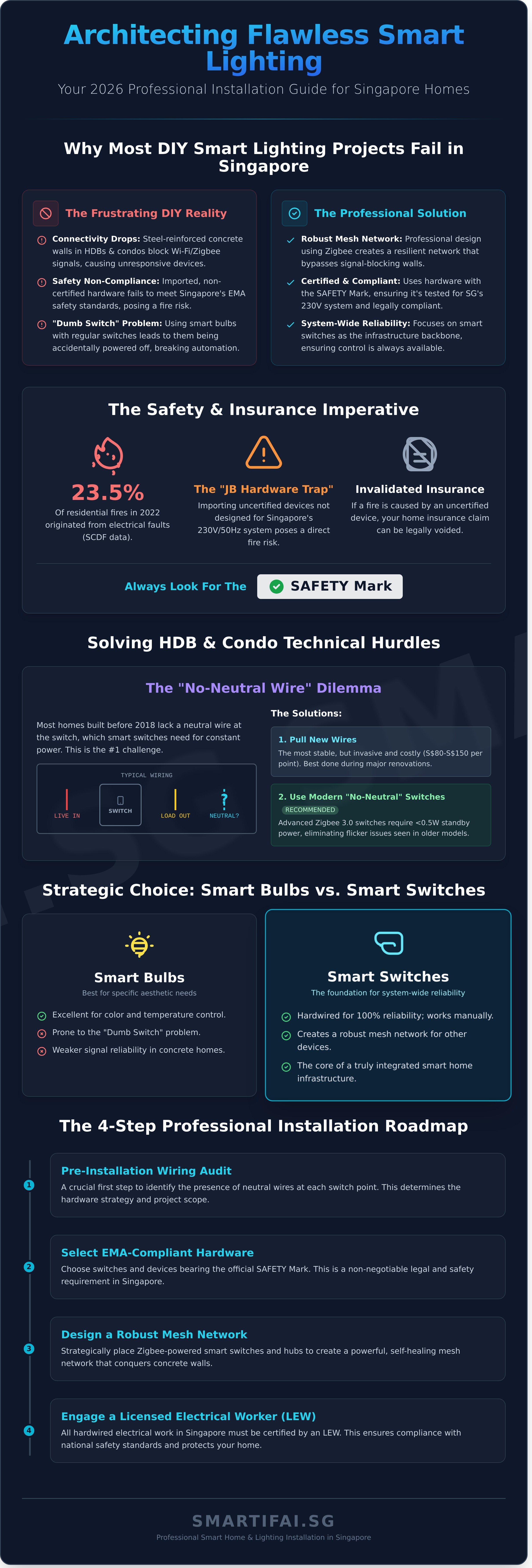
Choosing between smart bulbs and smart switches is the first critical decision in your smart lighting installation journey in Singapore. This isn't merely a choice of product; it's a fundamental decision about your home's control architecture. One offers aesthetic flexibility, while the other delivers unwavering reliability and system-wide intelligence. Your choice will define the daily user experience for your entire family.
The core issue with a bulb-centric strategy is what we call the "Switch Problem." A smart bulb is only smart when it has power. The moment a family member, guest, or cleaning helper instinctively flips the physical wall switch off, your S$80 smart bulb becomes a "dumb," unresponsive piece of hardware. Your voice commands fail, your automated schedules are useless, and the entire intelligent ecosystem for that room is broken until someone physically flips the switch back on.
Smart bulbs excel in targeted applications where dynamic color is the primary objective. Think of an entertainment room where RGB lighting syncs with your movies, or a nursery where you can program a gentle, color-shifting night light. In these isolated scenarios, they offer unparalleled creative control. However, deploying them as a whole-home solution presents significant challenges, especially in a typical Singaporean HDB flat or condo. Managing the Wi-Fi connectivity and firmware updates for 30, 40, or even 50+ individual bulbs creates a maintenance burden and clogs your network, leading to instability.
A smart switch strategy is architecturally superior for a robust and scalable smart home. Instead of placing intelligence in a disposable bulb, you embed it directly into your home's infrastructure. This delivers immediate and profound advantages:
This strategy of building a robust, centralized control system is the very essence of a modern smart home, reflecting the principles of connectivity and efficiency promoted by Singapore's Smart Nation initiative. The true foundation of this intelligent ecosystem lies in its core components; Smart Switches and Sockets are the architectural backbone that guarantees performance and scalability for years to come.
Executing a flawless smart lighting installation in Singapore requires a methodical, four-phase approach that moves beyond simple product selection. It’s an engineering discipline focused on future-proofing your home’s electrical infrastructure and creating a truly intelligent, responsive environment. This roadmap deconstructs the process from initial blueprint to final handover, ensuring your system is not only powerful but also resilient and intuitive.
The most critical phase happens before a single device is purchased. We begin with a comprehensive electrical audit, focusing on your home's Distribution Board (DB) box. In Singapore, over 30% of residential units built before 2005 may have legacy wiring or limited circuit capacity, creating potential bottlenecks for advanced smart systems. Our initial assessment identifies and mitigates these risks, preventing issues like flickering, overloaded circuits, or system instability down the line. This foundational step ensures your electrical backbone can support the demands of a fully integrated smart home.
Following the technical audit, we architect the lighting logic. This involves mapping automations to your lifestyle and Singapore’s unique equatorial sunlight patterns. We design scenes that, for instance, automatically adjust lights in east-facing rooms to a warm 2700K color temperature to complement the morning sun from 7 AM to 9 AM, while programming west-facing windows to activate cooler, brighter light to counteract afternoon glare. Visualizing these automated scenes is one thing; experiencing them is another. We invite you to visit our Ubi Smart Home Showroom for a live demonstration of contextual lighting in action.
With a robust plan in place, our licensed technicians begin the physical installation. All wiring and mounting are performed under the strict supervision of a Licensed Electrical Worker (LEW), ensuring full compliance with Energy Market Authority (EMA) regulations. The true power of a smart home is unlocked through seamless integration. We don't just install lights; we build a cohesive ecosystem. Imagine a "Movie Night" scene where a single voice command dims your ceiling lights to 15% brightness, activates television backlighting, and simultaneously signals your smart curtains to close, creating the perfect cinematic ambiance in seconds.
System resilience is paramount. A common concern is a loss of internet connectivity. Our architectures are designed with local processing protocols like Zigbee and Thread, ensuring that core automations-like motion sensors triggering hallway lights at 2 AM-continue to function flawlessly without an internet connection. Your physical smart switches always serve as the primary, failsafe control. The final step is the handover. This isn't just a quick demo; it's a 60-minute empowerment session where we train you to master your system via your preferred interface, whether it's Apple HomeKit, Google Home, or Amazon Alexa. You'll learn to create custom scenes, adjust schedules, and take full command of your new intelligent environment. Ready to move from concept to reality? Schedule your initial site audit with our engineering team today.
Standard smart lighting offers convenience. True intelligent lighting delivers an experience. As we look towards 2026, the benchmark for a smart home is shifting from remote control to genuine environmental autonomy. SmartifAi is pioneering this transition with Contextual Lighting, a system powered by our proprietary AI and advanced computer vision. It doesn't just respond to your commands; it anticipates your needs, processing visual and environmental cues in real-time to curate the perfect ambiance for any activity, moment, or time of day.
Imagine your living room lights subtly shifting to a cooler, focused kelvin temperature when our system detects you’re reading, or warming to a soft, ambient glow as it registers the sunset through your window. This is lighting that thinks, adapts, and enhances your life without a single tap. Our vision is to create spaces that are not just smart, but sentient.
This level of sophistication demands absolute end-to-end reliability. We manage every critical stage, from procuring enterprise-grade, certified hardware to executing a flawless installation. Our commitment extends far beyond the initial setup, with 24/7 technical support and proactive system updates. Our expertise in smart lighting installation singapore is tailored specifically to the diverse residential architecture of the nation. We are specialists in designing and implementing robust systems for HDB flats, multi-level condominiums, and expansive landed properties, ensuring optimal performance regardless of your home's layout.
Our track record is built on successfully deploying over 150 complex residential and commercial integrations since 2023, achieving a 98% client satisfaction rating. We move beyond the simple gimmick of remote control. Our core philosophy is "Contextual Intelligence," where your environment actively supports your lifestyle. This commitment is backed by high-level technical evidence and a team of certified professionals dedicated to engineering excellence and corporate reliability.
As we advance into 2026, the conversation around smart homes will be dominated by privacy. SmartifAi is engineered for this future. Our computer vision systems are built on a privacy-first architecture, processing all data locally on-device. No images or personal data are ever transmitted to the cloud, guaranteeing your home remains a private sanctuary. It’s a seamless marriage of performance and ethics, offering you unparalleled intelligence without compromise.
Your journey towards a truly intelligent environment begins with a professional site survey. Our specialists will assess your property’s unique characteristics, from existing wiring and natural light sources to your daily routines, to design a completely bespoke system. We provide continuous value through our post-installation maintenance plans, delivering software updates that ensure your system not only remains stable but evolves with our latest technological advancements.
Don't just automate your lights. Make them intelligent. Experience the future of smart lighting with SmartifAi.
The journey to a truly intelligent home is paved with strategic decisions, not just smart devices. As we've explored, navigating Singapore’s specific HDB electrical constraints and making the critical choice between smart bulbs versus switches are foundational pillars for a seamless system. Executing a professional smart lighting installation singapore homeowners can rely on for years demands this foresight, transforming isolated gadgets into a single, context-aware ecosystem that anticipates your every move.
At SmartifAi (Singapore UEN: 202124505G), we translate this technical complexity into effortless living. Our team consists of certified specialists in the future-proof Matter and robust Zigbee 3.0 protocols, ensuring your investment is both intelligent today and compatible tomorrow. We invite you to experience this innovation firsthand at our showroom, located at 71 Ubi Crescent. Stop imagining the future of home automation and start living in it. Book your professional smart lighting consultation with SmartifAi and let's architect an environment that elevates your life.
Not always. While optimal for stability, many HDB flats built before 2005 lack neutral wires at the switch. Modern no-neutral smart switches are engineered for these specific circuits, drawing minimal power to function. However, for the broadest compatibility and most reliable performance, a neutral wire is preferred. A professional assessment can determine the best solution for your home's unique wiring, ensuring a seamless and effective installation.
No, provided the installation is performed by a Licensed Electrical Worker (LEW). Major insurers in Singapore, including NTUC Income and FWD, require that all fixed electrical work complies with the SS 638 safety code. An LEW-certified installation guarantees this compliance and protects your policy. DIY electrical work or using an unlicensed handyman, however, poses a significant risk and could invalidate your coverage in the event of an electrical fault or fire.
Yes, you can maintain robust local control by choosing systems that use Zigbee or Thread protocols instead of relying solely on Wi-Fi. Brands like Philips Hue and Aqara use a central hub to create a dedicated mesh network for your lights. This architecture ensures that even if your internet connection drops, your switches, schedules, and automations continue to function flawlessly within your home over 99% of the time. Remote access is the only feature lost during an outage.
A smart bulb provides granular control over a single light source, including its colour and brightness. In contrast, a smart switch governs the entire electrical circuit, making all connected fixtures intelligent simultaneously. For a room with multiple downlights, a single smart switch is a more efficient and cost-effective solution. It also solves the key problem of smart bulbs becoming unresponsive when the physical wall switch is turned off.
Professional installation of a smart switch or light fixture in Singapore typically costs between S$70 and S$120 per unit. This fee covers the labour for a standard replacement. If new wiring is required, the cost can increase to S$150-S$250 per point. For a typical 4-room HDB flat, homeowners can expect a total installation budget of S$500 to S$1,200, depending on the project's scope and complexity.
Yes, Philips Hue demonstrates excellent interoperability with other brands, primarily through its comprehensive support for the Matter smart home standard. As of 2026, Matter acts as a universal language, enabling seamless integration between Hue lighting and devices from Apple Home, Google Home, Amazon Alexa, and Samsung SmartThings. This allows you to build a cohesive, future-proof smart home ecosystem without being restricted to a single brand's platform.
Yes, it's a legal requirement in Singapore. The Energy Market Authority (EMA) mandates that any replacement of a fixed electrical fitting, including a light switch, must be carried out by a Licensed Electrical Worker. This regulation ensures the work meets national safety standards. Engaging an LEW for your smart lighting installation Singapore project is essential for safety, compliance, and maintaining the validity of your home insurance.
Smart lighting can reduce your lighting-related energy costs by up to 30%. This efficiency is achieved through intelligent automation. For example, motion sensors ensure lights are only on in occupied rooms, while scheduling automatically turns off all lights when you leave. Dimming capabilities also play a key role; reducing an LED bulb's brightness to 80% saves nearly 20% of its energy use with minimal visible difference, directly lowering your monthly SP Group bill.
